Anton Ladnyi, CFA — Institutional Portfolio Strategy
A.L. Capital Advisory · Private Investment Strategy
Goldman Sachs · J.P. Morgan · CFA Charterholder
Institutional-grade strategy for private clients
0%
Opening Scheduling Calendar
Preparing your strategic session booking…
Markets
Book a Strategic Session
Anton Ladnyi — Founder, A.L. Capital Advisory
Private Capital Advisory · Warsaw

Your capital deserves
institutional
rigour.

The methodology your bank uses internally — applied to your specific numbers, by a single advisor accountable only to you. Not a team. Not an algorithm. Not a model portfolio. You see exactly what was done and why.

Institutional Background Goldman Sachs · J.P. Morgan
CFA Credentials L1  ·  L2  · L3
Professional Experience 10+ Years Investment Banking
Education MSc International Business Management
Portfolio Sharpe Ratio
1.24
vs. 0.68 benchmark average
0.47
Portfolio Correlation · Post-Session Average
48h
Health Check Delivery · Every Time
28K
Avg Annual Cost Drag Identified
1
Advisor · Direct Access · No Intermediaries

Based on representative client engagement outcomes across the A.L. Capital Advisory practice. Portfolio correlation and cost-drag figures derived from actual session deliverables; individual results vary by portfolio composition, horizon, and market conditions.

Career foundation
Goldman Sachs Equity Research · Warsaw
J.P. Morgan Wealth Management · UHNW
CFA Institute CFA Charterholder — February 2026
MSc International Business Management Graduate Degree
Investment philosophy
"Most private investors manage their wealth the way institutions managed theirs in the 1980s — without the framework, without the process, without the governance discipline that separates durable outcomes from fortunate ones."

The gap between how institutional capital is managed and how most private investors manage their own portfolios is not a knowledge gap. It's a systems gap.

At Goldman Sachs and J.P. Morgan, portfolio decisions are not made on intuition or market sentiment. They are made within a formal framework: defined allocation targets, stress-tested scenarios, written decision rules, and structured governance reviews.

My practice exists to close that gap. I apply the same quantitative frameworks, the same professional standards, and the same level of analytical rigour I brought to institutional mandates — to your personal portfolio. No products. No commissions. No conflicts. One advisor, fully accountable to you.

The structural problem

Most private investors
are operating without
a framework.

You have built meaningful capital through discipline and effort. Deploying and compounding it systematically requires something most private investors lack: an institutional-grade framework designed around your specific circumstances, constraints, and goals.

01 / 03
Reactive decisions, not strategic ones
No defined allocation framework. No rebalancing discipline. Portfolio decisions driven by headlines, market commentary, or gut instinct. The result: fragmented capital that grew by coincidence, not design — with no written investment mandate to anchor behaviour under stress.
→ Replaced by: A documented Investment Policy Statement with explicit decision rules
02 / 03
Advisors who distribute products, not strategy
Bank wealth management is a distribution channel. The advisor's compensation is structurally misaligned with your outcomes. You receive model portfolios designed for a segment — not your tax position, liquidity requirements, or actual risk profile. The IPS that governs your portfolio exists for the institution, not for you.
→ Replaced by: Fee-only advisory. Zero product commissions. Permanent.
03 / 03
No framework for high-conviction decisions
When markets move sharply, the question becomes: hold, rebalance, or exit? Without a pre-defined decision framework, every episode of volatility is a test of emotion rather than judgment. Institutional investors never face this choice — because the answer was written into the mandate before markets opened.
→ Replaced by: Pre-defined protocols for every scenario, embedded in your IPS
Sample Session Output

A Strategic Session
produces a concrete deliverable.

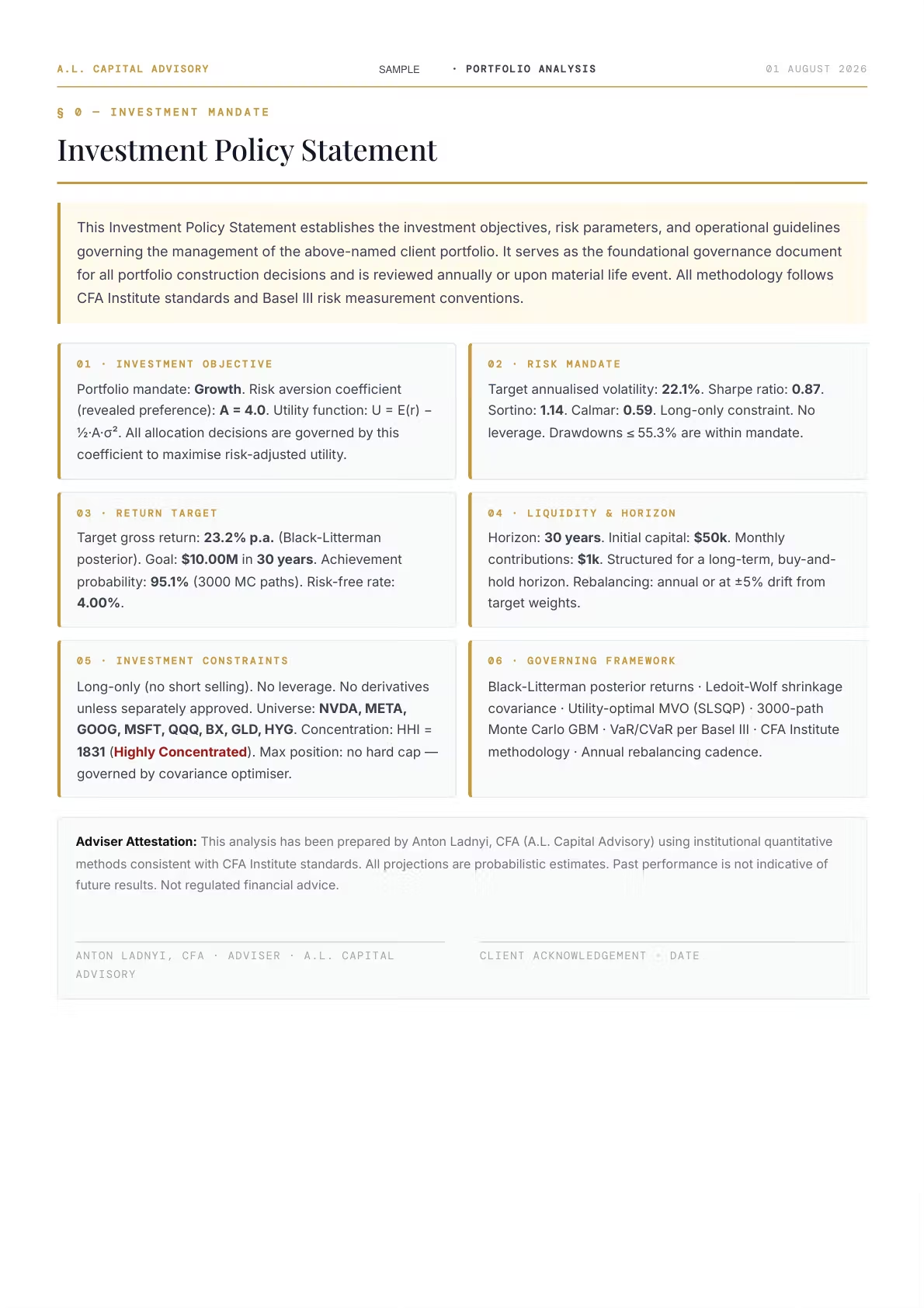
Below is a full representative Investment Policy Statement from the Strategic Session framework — anonymised and built on real quantitative output. Sixteen pages. Written mandate, holdings scorecard, Efficient Frontier, Monte Carlo wealth projection, historical stress tests, Euler risk decomposition, and a signed IPS. This is the document every institutional portfolio starts with. Now available for private clients.

AL
A.L. Capital Advisory · Sample IPS
Portfolio Analysis & Advisory Report
Pages · Format
16 pp · A4 · PDF
Download Sample Report
Deliverables included:
◈ IPS & Mandate ◆ Holdings Scorecard ◇ MC Simulation (2K paths) ◉ 6 Stress Scenarios ◎ Efficient Frontier ◑ Euler Risk Decomposition
Sample · Anonymised · For Illustration
Typical Transformation · Before & After the Session Representative
Before the Session
12 positions across 2 brokers — no written allocation framework or rebalancing rules
Portfolio correlation 0.86 — diversification illusion across equity-heavy holdings
Maximum drawdown: unknown. No stress-test against goals ever performed
Annual cost drag ~1.4% undetected across high-TER active funds and FX conversions
No Investment Policy Statement — every drawdown a novel decision made under pressure
After the Session
8-asset-class Black-Litterman allocation with written mandate, target weights, and rebalancing bands
Post-optimisation correlation 0.47 via Ledoit-Wolf shrinkage and factor diversification
Max drawdown quantified at −22% (P5, 10Y) — stress-tested across 10,000 Monte Carlo scenarios
€28K in annual cost leakage identified and eliminated through ETF substitution and restructuring
Written IPS delivered: rebalancing triggers, concentration rules, drawdown protocol — a governing document
0.47
Portfolio Correlation (post)
−22%
Max Drawdown P5 (10Y)
€28K
Annual Cost Recovery
0.81
Sharpe Ratio (optimised)
About Anton Ladnyi

Institutional rigour,
private accountability.

I spent over a decade building the analytical infrastructure that institutions depend on. At Goldman Sachs I led equity research and financial modelling across Central European markets. At J.P. Morgan I managed investment portfolios and P&L oversight for HNW and UHNW private clients across multi-asset mandates.

I am a CFA Charterholder who successfully passed the February 2026 Level III exam (50% pass rate) and have met all professional requirements — the global standard in investment management.

No products. No commissions. No conflicts.
One advisor, fully accountable to you.
CFA Level I Passed — CFA Institute Verified Verify ↗
CFA Level II Passed — CFA Institute Verified Verify ↗
CFA Charterholder Passed February 2026 · All Requirements Met Verify ↗
2017–2020 Warsaw
Goldman Sachs
Analyst → Senior Analyst · Equity Research
2021–2025 Warsaw
J.P. Morgan
Associate → Senior Associate · Wealth Management
2025– Active
A.L. Capital Advisory
Founder · Portfolio Architect
"The difference between institutional and private portfolio management is not complexity — it is discipline and governance. I now bring both to clients who have earned the right to demand them."
Anton Ladnyi, CFA · Founder, A.L. Capital Advisory
Anton Ladnyi — Founder, A.L. Capital Advisory
Anton Ladnyi, CFA
Founder & Portfolio Architect
Goldman Sachs · J.P. Morgan · CFA Charterholder
Proprietary framework

The analytical process
behind every engagement.

Every engagement begins with the same rigorous process I applied to institutional mandates — adapted to your life, timeline, and financial architecture. No templates. No model portfolios. No products to distribute.
01
Risk & Investment Profile
A structured profiling session — solving for your risk aversion coefficient, investment horizon, and financial constraints. Not a checkbox questionnaire: a quantitative process that surfaces your true risk capacity, revealed preferences, and return requirements.
Behavioural · Quantitative · Capacity
02
Strategic Asset Allocation
Mean-variance optimisation and Black-Litterman views combined to construct your strategic allocation — the governing framework determining where your capital is positioned across asset classes, geographies, and time horizons. Formalised in a written Investment Policy Statement.
MVO · Black-Litterman · IPS
03
Portfolio Simulation
Monte Carlo simulations model your portfolio across thousands of market scenarios — quantifying the probability of reaching your goals, identifying tail risks, and stress-testing your allocation before any position is taken.
Monte Carlo · Stress Testing · Scenarios
04
Decision Framework & Governance
A written set of decision rules: rebalancing triggers, drawdown protocols, review cadence, exit conditions. When markets move, you follow a process — not a reaction.
Rebalancing · Governance · IPS Review
All methodology follows CFA Institute standards — the same framework governing the world's most respected institutional asset managers. Verified CFA Level I and Level II credentials. CFA Charterholder. The tools are institutional. What changes is the focus: your goals, not a fund mandate.
The full mathematical derivation — Bayesian posterior updating, Ledoit-Wolf shrinkage, model governance — is documented in the working paper:
Portfolio Construction Under Parameter UncertaintyWorking Paper · February 2026 · Anton Ladnyi
The Methodology — Visible

Six frameworks.
One rigorous methodology.

Every engagement runs these exact models on your specific numbers. Before you book a session, you can run them on any asset, free, in this browser. The methodology should earn your trust before you spend a euro.

Risk Aversion Coefficient
01

ML Risk Assessment Model

A machine-learning model trained on thousands of investor profiles maps your responses to a precise risk aversion coefficient — the central input that governs every subsequent calculation. Unlike questionnaire scores, this coefficient is mathematically interoperable with portfolio theory.
Gradient Boosting λ coefficient Behavioural calibration
Posterior Weights
02

Black-Litterman Model

Developed at Goldman Sachs in 1990 to address MVO's sensitivity to return estimates, Black-Litterman combines market equilibrium returns with explicit views using Bayesian inference. The result is a stable, diversified allocation that reflects both the market's collective wisdom and reasoned forward expectations.
Bayesian inference Market equilibrium Goldman Sachs origin
10,000 Simulated Paths
03

Monte Carlo Simulation

Rather than projecting a single return line, Monte Carlo runs 10,000 independent market scenarios drawn from your portfolio's statistical properties — capturing sequence-of-returns risk, fat tails, and compounding variability. The output is a probability distribution over outcomes, not a forecast.
10,000 paths Stochastic modelling Goal probability
Expected Shortfall
04

CVaR & Tail Risk

Conditional Value at Risk measures what you lose on average in the worst scenarios — not just the threshold. Where VaR asks "what is the boundary?", CVaR asks "how bad does it get beyond that boundary?" The difference matters in fat-tailed markets.
Expected shortfall Fat tails Tail risk
Covariance Shrinkage
05

Ledoit-Wolf Shrinkage

Sample covariance matrices are notoriously noisy — they overfit to historical data and produce unstable portfolio weights. Ledoit-Wolf shrinkage corrects this by blending the sample matrix toward a structured target, dramatically improving out-of-sample portfolio behaviour.
Covariance estimation Regularisation Parameter uncertainty
Policy Document
06

Investment Policy Statement Framework

The IPS is the output that connects all models to real decision-making. It encodes your allocation, rebalancing triggers, concentration limits, and drawdown protocol into a written governance document — removing the emotion and ambiguity that erodes most private portfolios at the worst possible moment.
Rebalancing rules Drawdown protocol Written mandate
Proprietary instruments

The same analysis your bank
runs — except you see it.

Four instruments, four stages. Stages I–III are free tools that build the analytical foundation — permanently free, no signup, no trial. Stage IV — the Portfolio Health Check — is the first paid service: an expert-written diagnostic that translates your data into actionable findings, delivered personally by Anton within 48 hours.
Stage II · Complimentary · ~8 min
Risk Assessment
Live Tool
Free
3.4A coeff
Moderately Growth-Oriented
Risk aversion coefficient solved via revealed preference theory. Capacity score: 72/100.
Global Equities
62%
Fixed Income
22%
Alternatives
10%
Cash / MM
6%
20 questions · 5 modules · Black-Litterman MVO
Complimentary · No registration required · Immediate results Begin Assessment →
Stage III · Complimentary · Following Assessment
Portfolio Dashboard
Live Tool
Free
10Y Projected Value
€847K
Monte Carlo median
Expected Return
8.2%
Annualised, risk-adj.
Max Drawdown P5
−31%
Worst-case scenario
Sharpe Ratio
0.74
Risk-adj. efficiency
10,000 Monte Carlo simulations · Full allocation breakdown
Generated from your Assessment profile View Demonstration →
Client Outcomes

What clients receive
from a Strategic Session.

"I'd been investing for six years across three brokers with no real strategy. Anton spent 90 minutes turning that into a coherent framework I actually understand and trust. The Monte Carlo analysis alone changed how I think about my goals."
M.K. (sample) Co-Founder, SaaS company · Warsaw Portfolio: €180K+
Key outcome Portfolio correlation reduced from 0.84 → 0.51 across 6 positions
"Coming from finance myself, I had high expectations. Anton's process is genuinely institutional in quality — the risk profiling methodology, the allocation framework, the way he stress-tests scenarios. This is not what private banking delivers."
P.W. (sample) Senior Engineering Manager · Tech sector Portfolio: €320K+
Key outcome €26K in annual TER & FX drag identified and eliminated
"I had €10K saved and no idea where to start. I'd been overwhelmed by conflicting advice online for months. One session with Anton gave me a written framework, a first allocation, and the confidence to actually begin. That clarity had real value."
K.M. (sample) Graduate, first job · IT sector Portfolio: €10K · First-time investor
Key outcome First Investment Policy Statement written — a starting framework built to grow with the portfolio

Testimonials are anonymised to protect client confidentiality. Initials and sector only. Portfolio ranges are approximate.

Frequently asked

Questions prospective
clients ask first.

Why not just use my bank's wealth management service?
+
Bank wealth management is a product distribution business. The advisor is compensated by product sales — not by your outcomes. I work on a fee-only basis: no products, no commissions, no structural conflict between what serves you and what generates my revenue. You also gain direct access to the same analytical frameworks applied inside J.P. Morgan Wealth Management — applied by the person who actually built them there.
What exactly happens in the Strategic Session?
+
A 60–90 minute structured working engagement — not a discovery meeting, not a sales call. We review your quantitative risk profile, construct your strategic asset allocation, run Monte Carlo simulations against your goals, and produce a written Investment Policy Statement with your complete decision framework. You leave with a concrete, implementable deliverable: your personal investment mandate. The Strategic Session fee is €750, paid at booking. No hidden charges, no ongoing commitment.
Do I need a minimum portfolio size?
+
There is no capital threshold. The value of the engagement lies in the clarity and rigour of the strategy — whether you are deploying €50K or €5M. What matters is a genuine commitment to a systematic approach and the intention to act on the framework we construct together.
What do you mean by "institutional methodology"?
+
It means the same quantitative instruments and governance standards applied at Goldman Sachs and J.P. Morgan: specifically, mean-variance optimisation (Black-Litterman model), Monte Carlo simulation, utility theory for risk calibration, and a formal Investment Policy Statement. All methodology is grounded in CFA Institute standards. These are not marketing terms — they are the tools I used professionally for over a decade.
What is the Risk Assessment for?
+
The Risk Assessment is a 20-question quantitative profiling instrument that produces your risk aversion coefficient, capacity score, and optimal portfolio allocation — with a full Monte Carlo simulation. It is how every engagement begins. It takes approximately 8 minutes, requires no registration, and delivers genuine institutional-grade analytical output before we speak.
How do I continue working with you after the session?
+
The Strategic Session is a standalone deliverable — you receive a complete strategy document you can implement independently. If ongoing advisory is appropriate for your situation, we discuss the format during the session. Many clients begin with a single engagement and return for periodic portfolio reviews. The structure is always designed around your needs, not a standard service tier.
What is a Black-Litterman allocation and why does it matter?
+
The Black-Litterman model was developed at Goldman Sachs in 1990 to solve a fundamental flaw in classical mean-variance optimisation: tiny changes in return estimates produce wildly unstable portfolios. Black-Litterman corrects this by blending market equilibrium returns with Bayesian posterior updates of your specific views, producing stable, diversified allocations that don't concentrate absurdly into a single asset class. It is the industry standard at the institutional level — and the backbone of every allocation I construct for clients.
What is an Investment Policy Statement and do I really need one?
+
An Investment Policy Statement (IPS) is a formal governance document that defines your allocation targets, rebalancing rules, concentration limits, and drawdown protocols. Every institutional investor — pension funds, endowments, sovereign wealth funds — is required to operate under a written IPS. Private investors rarely have one, which means every market dislocation forces a decision made without a framework. The IPS removes emotion from the equation: you follow the process, not the news cycle. It is the single most important governance document your portfolio can have.
How is this different from a robo-advisor or passive ETF strategy?
+
Robo-advisors and passive ETF platforms provide generic, segment-based allocations — the same portfolio construction for thousands of clients with a similar risk score. They cannot account for your specific tax jurisdiction, liquidity constraints, existing holdings, behavioural biases, or concentrated positions. The Strategic Session produces a bespoke mandate: your actual risk aversion coefficient (not a questionnaire bucket), your actual constraints, and a Bayesian allocation calibrated to your goals — not to a product tier. It also produces a written IPS, which no algorithm delivers.
What does the Portfolio Health Check provide before a Strategic Session?
+
The Portfolio Health Check (€150, credited toward the session) is an expert-written diagnostic of your current holdings. It delivers: a full pairwise correlation matrix revealing hidden concentration; a Herfindahl-Hirschman Index concentration score benchmarked against institutional norms; factor attribution by sector; a quantified cost audit identifying TER and FX drag; and one single highest-leverage rebalancing action. Written personally by Anton within 48 hours as a PDF. If you proceed to the Strategic Session, the €150 is credited — you pay €600, not €750.
Still have
questions?
Applications are reviewed personally. Every response comes directly from Anton — not a template, not an assistant.
Book a Strategic Session →
Strategic Session
€750 one-time

One session.
An investment framework
built to last.

The Strategic Session is a 60–90 minute structured engagement that produces a concrete, implementable deliverable: your personal investment mandate, constructed to institutional standards.

Quantitative risk & behavioural profile
ML-derived risk aversion coefficient, loss-tolerance calibration, and behavioural bias assessment — the same methodology institutional desks use before constructing a mandate
Optimal strategic asset allocation
Black-Litterman and Markowitz MVO applied to your specific goals, horizon, and capacity — not a model portfolio. A personalised allocation built from first principles
Monte Carlo goal-probability simulation
10,000 forward market scenarios stress-tested against your target wealth. You'll know the probability of reaching your goal — and exactly what levers move it
Written Investment Policy Statement
A formal document you keep: rebalancing thresholds, drawdown protocols, concentration rules, and a written decision framework — your personal governing mandate
Broker & account architecture
Which brokers, which account types, and how to structure them for tax efficiency across German and EU jurisdictions — concrete, actionable, not generic
Implementation & cost audit
ETF selection, TER analysis, FX cost review, and execution sequencing. Every drag on your compounding identified and addressed
30-day follow-up window
Questions that arise after implementation reviewed directly by Anton. Email access for 30 days to ensure the plan is executing as designed
Currently accepting new engagements — reviewed personally by Anton
Completed the Health Check? Your €150 is credited toward this session. You pay €600, not €750.
Book a Strategic Session
€750
one-time · IPS included
Anton reviews every application personally and will respond within 24–48 hours.

Pick a time on the calendar, then check out securely via Stripe.

Your name, email and message are processed by A.L. Capital Advisory to respond to your enquiry and, if you proceed, to deliver advisory services (GDPR Art. 6(1)(b)). Data retained for 3 years. Privacy Policy

Or send an enquiry first

Application received.
Anton reviews every application personally and will be in direct contact within 48 hours.
📅 Schedule a time now →

Skip the wait — pick a slot directly